
Sunday Telegraph columnist Jeff Howell at www.askjeff.co.uk

home solar heating woodworm dry rot rising damp myth double glazing roof repairs pvc products textured wall coatings cavity wall insulation books contact me

This book is indispensable reading for house-sellers, buyers, surveyors, property professionals and construction students. It describes how “rising damp” has been promoted as a marketing device by the chemical damp-proofing industry, and explains the simple steps that every homeowner can take to make sure they are not bamboozled by surveyors or ripped-off by damp-proofing companies.

“If rising damp exists, then so does the tooth fairy. In this exhilarating detective story, Jeff Howell conclusively debunks a multi-million pound myth. Essential reading for all homeowners.”

“The damp-course industry holed below the water line. An entertaining factual account of the mis-selling of remedial damp-proofing work.”

Purchase this book from the author

Every week, on average, around 5,000 British homes are diagnosed as suffering from rising damp. Many of them are subsequently “damp-proofed”, by means of injected water-repellant chemicals or other methods.

But this rising damp is a strange beast. You can’t see it, you can’t feel it, and people are often surprised to be told, having lived happily in a property for many years, that their home is affected by it.

For the fact is that rising damp is a mythical building defect, which only came to widespread prominence in the 1960s, through the publicity of companies selling damp-proofing products. Rising damp is “diagnosed” by the mis-use of electrical moisture meters by Chartered Surveyors, and by commission-based salesmen for the damp-proofing companies, who describe themselves as “surveyors”.

Chartered Surveyors and Valuers carrying out mortgage valuation surveys are often the primary instigators of this unnecessary work. Owing to previous high-profile negligence litigation, they have been advised by their professional body, the Royal Institution of Chartered Surveyors (RICS) to use a “moisture detecting meter” to check structures for “hidden dampness”, and to then recommend “further investigation by specialists” (i.e. damp-proofing contractors). Even in the absence of high meter readings, many Chartered Surveyors still recommend “further investigation”, just to be on the safe side, thus leading clients into the hands of damp-proofing salesmen and contractors.

Contents

The rising damp myth. One of the most successful marketing tricks in the history of construction

The rise and rise of the electrical moisture meter

The origins of the phrase “rising damp”

How I eventually created rising damp, and found that it only occurs in swamps

The “science” of rising damp

The 1875 Public Health Act and the 1877 Model By-laws — how they came to be misinterpreted. And, if rising damp is a myth, why do the Building Regulations require DPCs in new buildings?

The history of remedial damp-proofing

The involvement of the BWPDA, the RICS and mortgage lenders in the rising damp myth

Real dampness problems in buildings, and how to diagnose and treat them

For Chartered Surveyors: how to break the circle of myth and ignorance

For homebuyers and sellers: how to counter the rising damp myth

Purchase this book from the author

"Rising damp" is a very rare phenomenon

So rare that many serious construction researchers have never seen it

Millions are spent each year in the UK "curing" the problem, but does it even really exist?

I have personally surveyed over 500 properties throughout the UK which have been diagnosed as suffering from rising damp, and I have found in every case that the diagnosis was wrong. So what is going on here? How come surveyors are finding rising damp where it doesn't exist?

The answer lies in commercial pressures. The "surveyors" who work for damp-proofing companies are actually salesmen. They make their money by taking a percentage commission on the damp-proofing work they specify. So if you invite a damp-proofing company to inspect your home for dampness problems, you should not be surprised if they "discover" its existence. That's how they make a living.

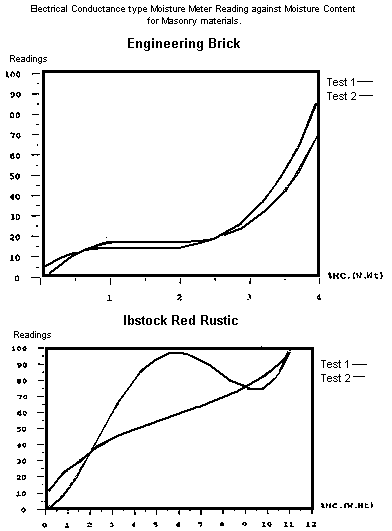
Damp-proofing salesmen use electrical conductance-type meters to "diagnose" rising damp. These are labeled "moisture meters", but they do not really measure moisture. They measure electrical conductance, and will give a reading on any building material which allows an electric current to flow through it. Clinker blocks, for example, which are made from coal ash, have a high carbon content, which means they conduct electricity. So clinker blocks will always give a high reading on one of these meters, even when they are bone-dry. These meters are actually calibrated for use on timber, and they can give reasonable approximations of moisture contents in wood, but on bricks, plaster and wallpaper they give readings which are way too high, and can easily be used to give the impression that a wall is damp when it is actually in a perfectly normal equilibrium moisture state with its surroundings.

The graph below shows the readings on two electrical conductance-type moisture meters against the actual moisture content of two types of brick. You can see that there is really no relation between the meter readings and the moisture content. And yet every day thousands of surveyors and damp-proofing salesmen stick these meters into walls and solemnly declare the presence of "rising damp"!

Oh, one final thing. "Rising damp" is an advertising phrase, invented by the damp-proofing industry to sell its products. "Damp" is an adjective, not a noun. So the correct English phrase should be "rising dampness". But that doesn't roll off the tongue quite so easily, does it?

Rising Damp?

Q. I am in the process of selling my house. The buyer's mortgage lender insisted on a survey for rising damp, and the surveyor's report says that there is extensive damp in all walls. There is no evidence of damp, such as wallpaper lifting, and a recent TV programme concluded that treatment for rising damp is seldom justified. What is your advice about current practice?

A. Rising damp is a myth. The 'surveyor', who says there is extensive dampness in all the walls is actually just a salesmen for chemical damp-proofing products. Tell your buyers that they need an independent dampness survey carried out to the standards described in Building Research Establishment Digest 245, and under no circumstances allow them to deduct the cost of damp-proofing works from the asking price.

Conflicting diagnoses

Q. I am buying a basement flat. Under 'essential repairs' the valuation survey report stated: 'You are advised to obtain a specialist rising damp report from a member of the British Wood Preserving and Damp-proofing Association, and carry out their recommendations in full. Any treatment undertaken should form part of a long-term insurance-bonded guarantee.' On the strength of this the mortgage lender withheld some money and we have now had four quotes from BWPDA firms. All of them indicated different damp spots in different parts of the house, and their estimates ranged from £600 to £3,750. Is there any reputable contractor you can recommend who provides an independent report on damp, preferably one whose views are respected by mortgage lenders?

A. Yes. Not a contractor but an independent surveyor. In my experience, there's no such thing as a reputable 'contractor'. Almost all damp-proofing/timber treatment contractors make their money by offering free surveys and then saying you need work done. The unreliability of their diagnoses is underlined by the fact that, as in your case, different 'specialist' firms usually come up with different proposals.


Independent damp and timber surveyors that I recommend (no commercial connection):


Abbey Independent Surveys – 01572 774 398

Website - www.abbeyis.com


Dampness Diagnosis Consultancy – 020 8657 3750

Website - www.dampnessdiagnosis.com


Many more readers' questions like these are answered in my book, "The Sunday Telegraph Guide to Looking After Your Property" - click on books towards the bottom of the menu for more information...

Rising damp rip-off that gave Madonna cold feet

(First published in The Sunday Telegraph)

There has been much excitement in the media over the news that Madonna, the American pop singer, has been planning to buy a home in London. And there is corresponding disappointment now she has decided, after months of house-hunting, that she has changed her mind.

Various theories for the cooling of the chanteuse's interest have been espoused, including the odd notion that the multi-millionairess may have been put off by the high prices. But the truth has been revealed in an interview with the rave culture magazine Mixmag, where the star is reported as saying, "I'm not gonna spend my life savings on some damp house! What is up with your real estate here?"

Now, I ask you, is it really likely that any self-respecting estate agent dealing in property in Madonna's price range would dare offer her a "damp" house? Stained wallpaper, crumbling plaster, condensation running down window panes - not exactly your Hollywood image of Hampstead or Holland Park, is it?

No, it is far more likely that Madonna will have viewed several perfectly sound houses, and been advised to have them checked over by a local Chartered Surveyor. The Surveyor will have prodded the ground floor walls with a simple electrical device known as a "moisture meter", and advised her to take further advice from a damp-proofing company. The damp-proofing company's salesman will no doubt have performed the same perfunctory prodding, and pronounced the presence of a defect known as "rising damp", the elimination of which could be effected by the same company's skilled operatives for a sum in the region of ten thousand pounds. Twenty five year insurance- backed guarantees available upon the payment of another couple of grand. No wonder Madonna decided to take the next flight back to LA.

But the fact is that homes in London, as in the rest of the world, do not really suffer from rising damp. They suffer from a surfeit of ignorant surveyors who believe that meter readings taken from the wallpaper are an indication of hidden moisture. The meters they use are actually measuring electrical conductance, and if they are pressed into the wallpaper of the average home, they will give a reading. This does not indicate a dampness problem; it indicates that the wallpaper, and the plaster behind it, are slightly electrically conductive. A higher reading will be given in the presence of moisture, but this is because wallpaper, and the paste that sticks it to the wall, are hygroscopic - that is, they absorb moisture from the atmosphere. And since the atmosphere inside a house is always cooler and more humid at ground level (because of the fact that warm air rises, and cooler air sinks), then it is always possible to get higher meter readings at low level. This does not indicate rising dampness; it indicates ignorance. And, in the case of the damp-proofing companies, it indicates a wonderful marketing opportunity.

When Madonna gets back to America, she may come across the news that Harry Potter, hero of the best-selling children's' books, has been branded a Satanist and Antichrist by a parents' association in South Carolina. Harry's secret persona as a schoolboy wizard has apparently raised the suspicions of some eagle-eyed moms and dads, who suspect him of being Lucifer's fifth columnist in the New World. Those Americans, eh? Crazy, or what?

The funny thing is, though, that the British author J K Rowling based Harry Potter's character on that of a damp-proofing contractor from Bristol. And since the whole damp- proofing game is based upon witchcraft ... well, it makes you think, doesn't it?

Jeff Howell