Sunday Telegraph columnist Jeff Howell at www.askjeff.co.uk

home latest news woodworm dry rot rising damp myth double glazing roof repairs pvc products textured wall coatings cavity wall insulation books contact me

Foam roof undercoating

Spray-on roof repairs should be avoided - unless your home is really about to fall down

Spray-on foam

Q. Every year gusts of wind dislodge one or two of my roof slates. The roof is in its original 1920s condition with no underfelt. There are adverts in the papers for a 'foam spray solution' for old roofs. These are guaranteed for twenty or so years. Is this the easiest way forward, or should we look to get the whole roof redone?

A. The fact that slates are slipping every year probably indicates that the nails which hold them to the timber battens are rusted through. Roofers refer to this as nail fatigue or nail sickness, and it is definitely time to have the roof stripped off and re-covered. Having foam sprayed on to the undersides of the slates may sound like a wonderful high-tech solution but it is actually a bad idea. It is at odds with the recommendations of the Building Regulations, which require a clear 50mm ventilated gap between insulation and roof covering. The foam sets hard and removes the two vital attributes that allow a traditional roof to last and perform so well for so long - the ability to breathe and the ability to move. The foam completely encloses the timber battens and the top surfaces of the rafters, which might cause them to rot. It also sticks tight to the slates and makes it almost impossible for them to ever be re-used. You will also probably find that the cost of the spray-on foam solution will be three or four times that of having the roof re-covered in the traditional way. Try to find a roofer who will remove the existing slates carefully, and re-use as many as possible. Also make sure that the roofer uses a breathable sarking felt, and allows it to sag between the rafters. The ridge tiles and any hip tiles should be rebedded using lime-and-sand mortar to match the original; do not allow the roofer to use sand-and-cement.

Flat roof coverings

Q. The felted flat roof of my rear extension is leaking, and a number of firms are offering apparently foolproof solutions, such as fibreglass, rubber membranes, and jointless glassfibre-reinforced plastic coverings. These systems are all promoted with a variety of impressive-looking glossy brochures and promises of 25-year guarantees.

A. Flat roofs in Britain are notorious for leaking, and the problem does not usually lie with the roof covering material, but with poor workmanship. 'Flat' roofs actually need a fall of at least four degrees, a requirement which is often neglected. And if the timber roof joists are not thick enough, they can sag in the middle, allowing water to pond, and find its way through any minor defect.

The problem with most of the 'instant fix' flat roof repairs on the market is that they simply cover the existing leaking flat roof with a new waterproof coating, which will not remedy the underlying causes of the leak. This is throwing good money after bad. The GRP (glassfibre-reinforced polyester) and glassfibre flat roofing systems are often advertised as having 'no joints', as if this was an advantage, but in fact a large flat roof area exposed to sunlight should always have movement joints to cope with thermal expansion. If there are no joints then there may be expansion damage later on. And the 25-year 'guarantees' are usually meaningless. Also, the prices charged by these companies are often greater than the cost of getting the roof re-covered properly using tried and tested traditional methods. Modern high-tensile roofing felts should last for fifty years if they are installed properly.

Flat roof repairs

Q. Where can I obtain information on DIY flat roof repairs? I am an accomplished DIY enthusiast and am confident that I can carry out the necessary work properly but would like some tips on the correct method to adopt.

A. Try the Flat Roofing Alliance, which publishes a free booklet, 'The Householder's Guide to Flat Roofing', and a more detailed handbook for £17.50 (www.fra.org.uk/home.html)

Many more readers' questions like these are answered in my book, "The Sunday Telegraph Guide to Looking After Your Property" - click on books towards the bottom of the menu for more information...

The roofing job that gives bodging a bad name

(First published in The Sunday Telegraph)

The origin of the term "bodging" is the old custom of sealing the headlaps of roof tiles by trowelling on lime-and-horsehair mortar from the inside. This traditional practice stopped rain or snow being blown in, whilst still allowing the roof to "breathe".

It is obvious how, from such noble beginnings, the word "bodge" later came to refer to a clumsy bit of plastering or other repair work, and thence to its modern use for any kind of bad work. It is also ironic that one of the biggest bodges around now is the sealing of roofs against the elements from the inside - only the modern bodging, rather than using dollops of lime and horsehair, is to spray the whole roof with foam.

I wrote about this practice a few months ago, pointing out that spraying foam onto the undersides of slate or tile roofs is actually a bad idea. It is advertised as a cheap alternative to a proper roofing overhaul, but is very much a short-term solution; the foam makes it difficult for the slates or tiles to ever be re-used, and increases the likelihood of condensation in the rafters and battens, hence hastening the process of wood rot.

The National Federation of Roofing Contractors, which represents the responsible end of the roofing industry, even publishes a Technical Bulletin on the subject, which points out the risks that foam under-coatings pose to roof timbers. The Bulletin advises that the foam should not make contact with any of the timbers, which - since the process involves spraying foam over the battens - is clearly not possible. A spokesman for the NFRC told me that the only situation where he could recommend a foam under-coating would be to extend the life of an old dilapidated building, such as a farmer's barn, for another few years until it was demolished. He said the system was unsuitable for domestic properties, as it interferes with the two essential principles of good roofing practice - that a roof should be able to move, and that it should be able to breathe.

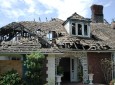
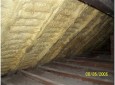
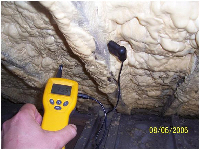
spray foam roof repair - wet eaves spray foam roof repair - wet hip rafter spray foam roof repair - timber moisture above 35%

The foam under-coating industry has naturally been very upset by my comments, and insists there have been no reported cases of condensation or wood rot. This is hardly surprising, as even if any of the industry's clients were in the habit of climbing ladders and crawling around on their roofs to check for problems, they would be unable to see much - the foam stops tiles being lifted from the outside, and the battens are hidden by foam on the inside. The condensation and rot are taking place out of sight and out of mind.

Apart from denying the existence of any problems, the foam sprayers are also not above making fanciful claims for their product. One firm was recently pulled up by the Advertising Standards Authority for falsely claiming that the process was "Government approved", and "Recommended by Chartered Architects and Surveyors". Adverts for foam under-coatings also regularly claim compliance with the Building Regulations, which is difficult to comprehend - my copy of the Building Regs makes it clear that where insulation follows the pitch of a roof, there should always be a clear ventilated 50 mm air gap between the insulation and the roof covering.

So if you are thinking of having your roof under-coated, then think again. And if you have already had it done, and feel that the product has been mis-sold to you, then you may wish to discuss it with your local authority Trading Standards Office.


Jeff Howell